

PRESENTING SUPERB RESEARCH THAT ADVANCES THE FIELD OF EDUCATION
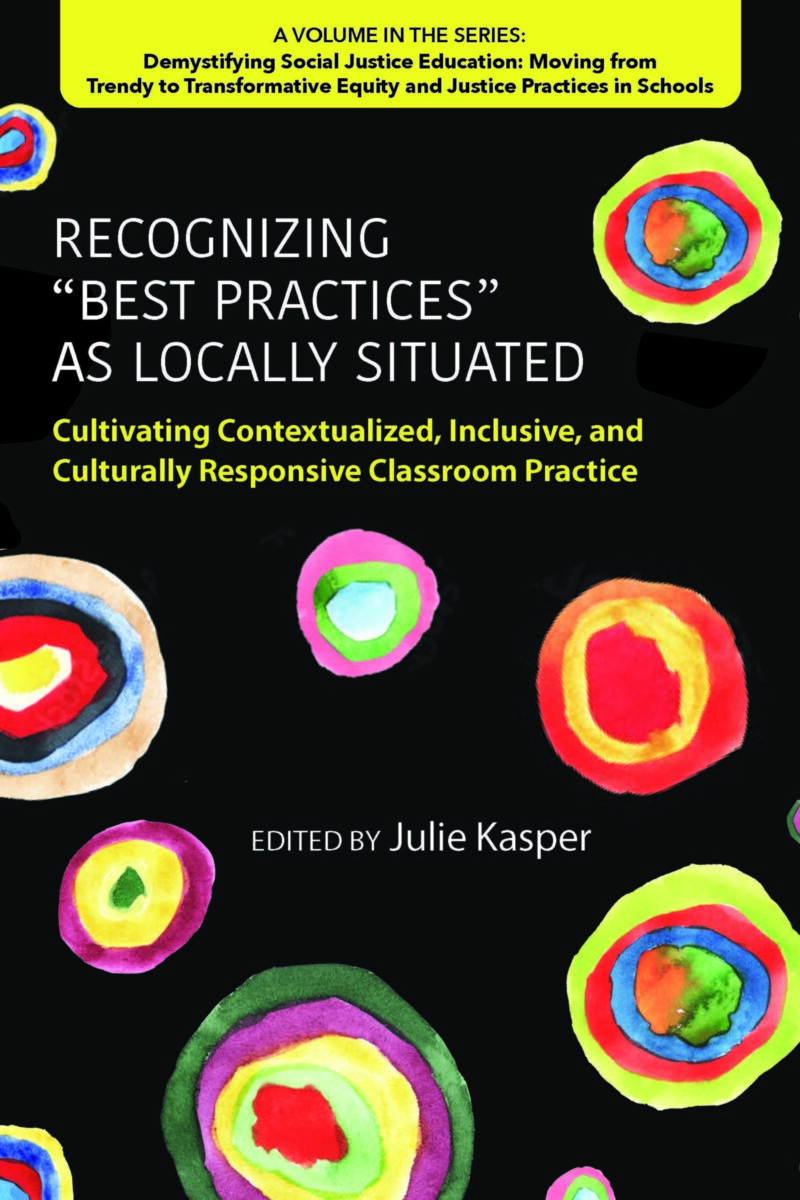
Recognizing “Best Practices” as Locally Situated
Cultivating Contextualized, Inclusive, and Culturally Responsive Classroom Practice
- Publisher
Myers Education Press - ISBN 9781975509194
- Language English
- Pages 250 pp.
- Size 6" x 9"
- Request Exam Copy
E-books are now distributed via VitalSource
VitalSource offer a more seamless way to access the ebook, and add some great new features including text-to-voice. You own your ebook for life, it is simply hosted on the vendor website, working much like Kindle and Nook. Click here to see more detailed information on this process.
- Publisher
Myers Education Press - ISBN 9781975509200
- Language English
- Pages 250 pp.
- Size 6" x 9"
- Request E-Exam Copy
Teaching in PreK-12 classrooms requires not only pedagogical
knowledge and field-related skill, but also creativity, flexibility, and
responsiveness. Teachers, as lifelong learners and as leaders in education,
must make sense of curricula, policies, research, and evidence in order to
guide and shape their practices in unique and diverse contexts. How teachers
make use of these “best practice” guides varies — there is no one-size-fits-all
program or method that can be picked up and applied without classroom teachers’
localized and reflective contextualization.
Designed for use by preservice teachers, experienced educators, mentors and
coaches, school leaders, and teacher preparation faculty, Recognizing “Best
Practices” as Locally Situated calls teachers into their power to disrupt,
transform, and lead towards change in PreK-12 schools. This volume makes
visible the critical work teachers engage in daily as they evaluate, interpret,
implement, and assess the impact of particular strategies, resources, and
approaches in their classrooms. Teachers must iterate on their teaching
practice in cycles of continuous learning and reflection toward educational
equity and social justice.
This book celebrates the voices, power, and pedagogical practices of teachers
across a variety of content areas and settings, ranging from early childhood to
adolescence and from transnational contexts, including multilingual classrooms
in the U.S., Lebanon, and Ukraine, along with teacher preparation programs in
the U.S. and Europe. Through vignettes, analysis, reflective prompts, lesson
plans, resources, and activities, the authors make clear that teachers are
agentic, innovative, and adaptive practitioners who translate evidence-based
“best practices” into context-specific, responsive, and learner-centered
pedagogical moves that build upon the assets of their students to support
learning. They invite readers into their (trans)local worlds as readers’ shape
and reconfigure their own (trans)local classrooms, schools, and educational
ecosystems.
Recognizing “Best Practices” as Locally Situated aims to bring together
the voices of practitioners across K-12 education to examine their situated and
expert testing, adaptation, and refusal of “best practices” within their
classrooms and communities. The authors explore a best practice, as housed in this
partially archived version of the U.S. Department of Education's Best Practices
Clearinghouse or as explicitly named in research or practitioner literature.
They explain the ways they have tested, accepted, rejected, modified, or
otherwise adapted and contextualized that “best practice” within their own
teaching context and with equity, inclusion, diversity, belonging, and social
justice in mind. Recognizing “Best Practices” as Locally Situated
provides an important overview and critique of currently circulating “best
practices” for both novice and experienced educators. It provides
classroom-tested pedagogical modes and resources with methodologies for
engaging critically with “evidence,” including through generation of new
evidence and knowledge bases situated within particular communities, times,
places, and policy contexts.
Perfect for courses such as: Introduction to Diverse Classrooms;
Introduction to Educating For Equity And Social Justice; Cultivating Culturally
Responsive Classrooms; Critically Reflective Teaching; Literacy Methods in
Multilingual Classrooms; Inquiry-Based Professional Learning; Introduction to
Teacher Leadership And School Improvement
Julie Kasper
Julie Kasper holds a PhD in Educational Leadership and Policy, an MA in TESOL, and she currently serves as K-12 Multilingual Education Instructional Coach in a large school district in Washington.
Kasper is a National Board Certified Teacher. Kasper taught English as a New Language in K-12 schools for 16 years before transitioning into nonprofit, research, and leadership work focused on refugee/(im)migrant education, education leadership, and critical pedagogical and policy practices across diverse U.S. and global contexts. Kasper regularly engages in co-creative processes that support and sustain learning, unlearning, and relearning in communities of care and communities of practice.
Her work with educators and students as co-equal learners and leaders in schools sits at the intersections of critical theory, collaborative research, and culturally relevant, responsive, and sustaining pedagogies. Kasper is most interested in the possibility-space intraactively becoming within transnational education ecosystems.

